Accepted by the UK Government

In the UK you don't need a solicitor or a court to change your name. This tool creates your legally valid deed poll in minutes, then walks you through what to do next.
There is no government office that ‘processes’ a UK name change. Instead, you sign a deed poll — a legal declaration that you are giving up your old name and will be known only by a new one. Once you have signed it in front of two adult witnesses aged 18 or over, your new name is legally yours from that moment.
You then present the signed deed poll to each organisation that holds records for you (HM Passport Office, the DVLA, HMRC, your bank, employer, utilities and so on), and they update your name on receipt.
This generator creates the deed poll for you, using the established legal wording for England and Wales. No solicitor is required. No court is involved. No government approval is needed.
You need a deed poll for any name change that isn't covered by a life-event certificate: a completely new surname, a double-barrelled or hyphenated surname, a change of first or middle name, changing a child's name, or reverting a name mid-marriage.
You don't strictly need a deed poll for a straightforward change of surname on marriage or civil partnership — a certified copy of your marriage or civil partnership certificate is enough. After divorce, most organisations accept the decree absolute alongside your birth certificate for reverting to your maiden name. When in doubt, a deed poll is universally accepted and takes the question off the table.
Read more: do I need a deed poll?, after marriage, after divorce, for gender reasons, or for a child.
Your new name is legally yours from the moment the deed poll is signed and witnessed. From there, updating your records is the practical work: usually two to six weeks of notifying each organisation. HM Passport Office usually delivers a passport within 3 weeks. DVLA advises allowing up to 4 weeks for postal applications, while banks often update within a few working days.
Most people start with HM Passport Office or the DVLA — updated photo ID makes updating everything else easier. Then work through HMRC, your bank, your employer, GP, utilities and any subscriptions. Our free name change checklist tracks every organisation for you so nothing gets missed.
The generator supports both adult and child name changes. Adult applies to anyone aged 16 or over. Child applies to anyone under 16 and requires the signature of everyone with parental responsibility.
For a child, parental responsibility is held automatically by the mother, and by the father if he was married to the mother at the child's birth or if he is named on the birth certificate for a birth registered in England and Wales after 1 December 2003. Step-parents, grandparents and civil partners do not have parental responsibility unless they have obtained it through a parental responsibility agreement, a court order or adoption. If you're not sure who needs to sign, our child name change guide covers every scenario.
Select the type of deed poll you need.
For anyone aged 16 or over changing their own name.
For changing the name of a child under 16, signed by parent(s) or guardian(s).
Enter your details exactly as they should appear on your deed poll.
This is not written on your deed poll. It is used only to tailor the guidance and offers shown after generation.
The date your deed poll takes legal effect — usually today's date or the date you plan to sign it. This is not your date of birth.
Where should we send your deed poll? We'll email you a copy along with step-by-step signing instructions, so it's safe even if you can't print right now.
Enter the child's details and the details of the parent(s) or guardian(s) with parental responsibility.
This is not written on your deed poll. It is used only to tailor the guidance and offers shown after generation.
The date this deed poll takes legal effect — usually today's date or the date you plan to sign it. Not the child's date of birth.
Where should we send your deed poll? We'll email you a copy along with step-by-step signing instructions, so it's safe even if you can't print right now.
Yes. An unenrolled deed poll does not need to be produced by a solicitor to be legally binding. Provided it uses the correct wording, is signed in both your old and new names, and is countersigned by two adult witnesses aged 18 or over, it carries full legal weight under English and Welsh law. HM Passport Office, the DVLA, HMRC, banks and building societies all accept it.
You sign a deed poll (a legal declaration of the change), then use it to update your records with each organisation. There is no central register, no government approval, no court involvement and no waiting period. Your new name is legally yours the moment the deed poll is signed and witnessed.
No. In England and Wales you can change your name without a solicitor and without any court appearance. A deed poll signed by you in front of two adult witnesses aged 18 or over is enough on its own.
The legal wording is identical — both create the same legally valid document. The difference is presentation and convenience. A paid deed poll is printed on premium certificate paper with an embossed gold seal and posted to you. Some organisations, particularly HM Passport Office and the DVLA, are more receptive to a formal-looking original.
Yes. Your deed poll should be signed in front of two adult witnesses aged 18 or over. Both witnesses sign and provide their names, addresses and occupations. Friends, colleagues or neighbours are sensible choices because some organisations may reject close relatives or people living at your address.
You can, though a marriage certificate is enough on its own if you're simply taking your spouse's existing surname. A deed poll is needed for anything more complex: double-barrelled surnames, meshed surnames, taking a completely new name, or changing your first name at the same time. Read more in our marriage name change guide.
Yes. A deed poll is the cleanest way to revert to your maiden name or take a completely new name after divorce. Most UK organisations also accept a decree absolute alongside your original birth certificate for reverting to a maiden name. Full detail: divorce name change guide.
Yes, provided you have consent from everyone who holds parental responsibility. Divorce does not remove parental responsibility, so an ex-partner with parental responsibility still needs to sign. If a parent refuses to consent, the change cannot proceed without a specific issue order from the family court. See our child name change guide.
Start with HM Passport Office or the DVLA — updated photo ID makes everything else easier. Then HMRC (through your Personal Tax Account), your bank, your employer, GP, utilities, subscriptions, insurance, pension providers and anywhere else that holds records. Our free name change checklist tracks every organisation.
UK naming rules are relatively unrestricted. Names are refused if they are offensive or vulgar, contain numbers or symbols, include titles you're not entitled to (Lord, Sir, Dr, Reverend), are impossible to pronounce, are unreasonably long, promote criminal activity or could be used to deceive. Otherwise the choice is yours.
Legally, only organisations that hold your records. Family and friends are entirely up to you. If you are on the sex offenders' register or subject to notification requirements, you must inform the police within three days. Bankrupts must inform the Official Receiver. Otherwise there is no duty to notify anyone about the change itself.
The deed poll itself is signed the same day and takes effect immediately. Updating your main records typically takes two to six weeks: HM Passport Office usually delivers a standard passport within 3 weeks, DVLA advises allowing up to 4 weeks for postal applications, and banks often update within a few working days. Your new name is legally yours throughout — you're just waiting on paperwork to catch up.
A deed poll is the standard document for changing your name in the UK and is what almost every organisation asks for. A statutory declaration is a different document with a different purpose — a sworn statement of fact, not a name change. Unless an organisation has specifically asked for a statutory declaration, use a deed poll. See our deed poll vs statutory declaration comparison.
Yes. There is no limit on how many times you can change your name by deed poll. Each change requires a new deed poll and a fresh round of notifying organisations. Your old name remains part of your history (for example on your original birth certificate) but stops being your legal name.
No. The generator is free, no account is required and no payment details are collected. A professionally printed version on certificate paper with an embossed seal is available as an optional purchase after you've generated the free document — but the free version is legally valid and you're under no obligation to buy anything.
Note: This generator produces unenrolled deed polls under the law of England and Wales. We are independent and not affiliated with HM Government. This is general information and not a substitute for legal advice. If you need an enrolled deed poll, apply through the UK Government website.
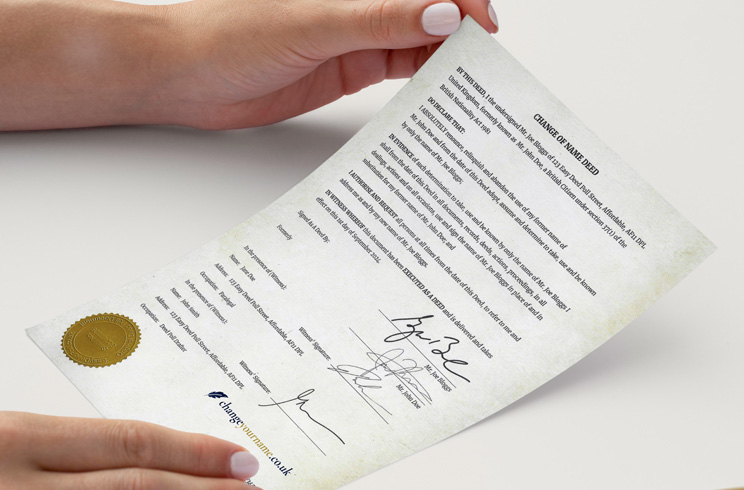
Individually prepared on premium certificate paper with an embossed gold seal. £14.95 with free delivery.
Start your application →
Skip the printer. We'll prepare the document you've just created on premium certificate paper with an embossed gold seal, and post it tracked within days. £14.95 with free delivery — most services charge £20+ plus postage.
Post me my sealed deed poll →